Monday, April 09, 2007

The Teachings of Don Juan by Carlos Castaneda

"A man goes to knowledge as he goes to war, wide awake, with fear, with respect, and with absolute assurance. Going to knowledge or going to war in any other manner is a mistake, and whoever makes it will live to regret his steps."
"When a man has fulfilled those four requisites there are no mistakes for which he will have to account; under such conditions his acts lose the blundering quality of a fool's acts. If such a man fails, or suffers a defeat, he will have lost only a battle, and there will be no pitiful regrets over that."

These are the words with which Carlos Castaneda opens his controversial book. From here, the reader is lead into an amazing new world, that of Don Juan Matus, the Yaqui Indian shaman. This world is filled with mystery, exploration, confusion and discovery. And with incredible psychedelic journeys affected by the hallucinogens contained in the peyote (a cactus local to Mexico, a.k.a. Lophophora williamsii - don't even try finding it at Canadian flower shops). And all this written before the cultural-religious-spiritual study before the hippy movement, Timothy Leary, or the Merry Pranksters!

Castaneda, during his course of study with don Juan Matus, Yaqui 'man of knowledge', learned to move into a non-ordinary reality, and experience not only magical events (he claims to have flown and grown a beak, among other things), but also that the ways of knowledge and power are difficult and dangerous.

Evidently, Castaneda has given a good deal of ammunition to the skeptics by stating during interviews that he would give false information about himself. This may have been simply a way for him to remind us Westerners that our methodologies are not the only way to know, and that one must look beneath the words and convenient "facts" to find the truth. The foreword declares that this book is both ethnography and allegory. The part of the allegory that is perhaps most exciting is the tension between Western science and other ways of knowing. Castaneda came to don Juan, proud and arrogant, and learned from him a healthy amount of humility and respect.

One of the lessons that Castaneda learns is the difference between a "power" and an "ally." Most individuals can become sorcerers by using a power, but to gain an ally, which is much more potent, one must work with the forces of nature, and learn the ways of real knowledge, following only the way of the heart (a thought also surfacing in the my previous review of Paulo Coelho's The Alchemist). It is of prime importance for the planet that all follow the way that has heart, turning toward the universe with respect. As it stands, most of us treat the earth as a natural resource only, to be exploited and discarded once used. Such actions and attitudes may give one temporary power, but at enormous expense to oneself and one's habitat.

Time and again, Don Juan's lessons remind us that we are not as powerful as we think. His lessons lead Castaneda into situations in which the anthropologist acts like a fool: rolling around on the ground for hours; playing with and actuing like a dog; clapping his thighs and assuming a "fighting form" for hours to regain his lost soul. These actions are apparently integral parts of Yaqui culture, but to Westerners they look foolish when performed by a supposedly "enlightened" and "objective" student of anthropology. Castaneda, in his search for power, must become, at least for a while, a fool. Dignity is a small price to pay for Don Juan's reminder that we are out of balance with the universe.

This book, though not among the greatest of literary achievement, is nonetheless recommended for those interested in counterculture movements of the 1960s to the present, mysticism, philosophical discussions of reality, drugs, and native American anthropology. In the larger sense, its lessons are of value for all Westerners: it is a subtle reminder of our temporary place in the universe, and of the costs of the way of power and knowledge.

Monday, April 02, 2007

A day at the Gardiner

My wife, a very good friend and I spent yesterday at Toronto's Gardiner Museum of Ceramic Art. We were planning to view their new special exhibition, On the Table (100 Years of Functional Ceramics in Canada). Though there were some interesting pieces among the contemporary artists' works, none really attracted me as much as the functional while magnificently decorated ancient pottery from Mexico and Central and South America produced centuries, perhaps thousands of years ago by the proud cultures of the Aztecs, Toltecs, Mayas and Incas.

Friday, March 23, 2007

Kodo and the magic of taiko

I have been in love with the taiko since I saw the Toronto-based group Yakudo play at the Japanese Canadian Culture Centre. Since that I have always wanted to hear the world's best.

Last night my wife and I had finally the pleasure of seeing, hearing and feeling one of the world's foremost taiko (Japanese drum) groups, Kodo perform live at Toronto's Massey Hall. This was an unforgettable experience! The amazing precision of the players, their total focus on both their own instrument as well as on their fellow group members' play, the exciting variety of compositions, and the enormous amount of energy released, all collaborated to produce something truly magical.

The Kodo show did not present taiko only but a great number of other Japanese instruments (fue, shamisen, etc.) and beautiful songs as well.

The occasional humour let people's mind and sould ease up a little from all the vibrations that made our bodies (certainly mine) resonate to the beat of the great taiko.

Some say the vibrations of the great taiko resemble the heartbeat (one meaning of Kodo, the group's name) of the mother, and make babies fall asleap. Well, there was an amazingly well-behaved little boy in the row in front of us, who, after being initially startled by all the noise of the drums, started to become somewhat restless. Clearly, the show was getting too long for him. However, as the great taiko began roaring, he started to quiet down, eventually almost fell asleep as well.

One thing is for certain. Once you hear the sound of the great taiko, not much else will have room in your body and soul. Its thunderous sound has a cleansing effect. It purifies by not letting anything else in. Its vibrations inside the body cause something akin to a meditative state where one exists in a beautiful world of harmony and rythm.

Something everyone must experience!


Sunday, March 11, 2007

The Sibling Society by Robert Bly


In this truly thought-provoking book the author reflects on the reality of our current society having lost its bearings (traditionally based in the moral absolutes of religion) in that it encourages people to not grow up and become adult members of a structured society. Rather, our present culture makes it clearly more attractive for its members to stay turned-inward, selfish and reckless adolescents for life.

Rather than simply acknowledging this phenomenon, Bly goes on and asks: "How did we move from the optimistic, companionable, food-passing youngsters gathered on that field at Woodstock to the self-doubting, dark-hearted, turned-in, death-praising, indifferent, wised-up, deconstructionist audience that now attends a grunge-music concert?" He interrogates reason. But there is no clear answer to this question nor is an easy answer as to possible solutions.

Bly, who is also known as "the man man" for his efforts at helping men rediscover what he calls the "mythopoetic" roots of masculinity through reenactments of various primitive male-group initiation and similar rituals, attempts, through fables and fairy tales, to map out when and how the transition occurred from a paternalistic society into the current society of father- and motherless siblings. In the "sibling society" boys do not struggle against their fathers any more, there is no more oedipal love between mother and son, or father and daughter. Rather, the horizontal (flattened) family model, from which the classic moral values have been removed, advocates to its young to look at fame as the only value proposition. "If you are not famous, you failed in life" - is the new creed.

Unfortunately, Bly offers no clear way out. He is too involved in putting his thoughts into a socio-scientific poem. His valid alarm, that our culture is in for a very rude awakening if we do not get our fathers and mothers back into the family, comes with some rather confusing commentaries on topics such as "vertical thought" or the psychoanalysis of "Jack and the Beanstalk" story and the Hindu myth of Ganesha, the lord of beginnings and eliminator of obstacles.

I would have liked to read about ideas moving us forward. Maybe it is a shortcoming I have developed through my work, but I do prefer solutions, however immature, over statements of problems and difficulties, however precisely presented.

Rating: 3 out of 5
Canadian Bead Oasis Show

We visited our friend Vera at the Oasis Bead Show in Toronto's downtown. Although I am not really into beads, I was happy to find some amazing handcrafted beauty. Magnificent artwork from Tibet. Of course, there is now also the inevitable mass-produced cheap junk that may eventually kill the real artist's ability to make decent living.

Sunday, February 11, 2007

Canada is beautiful in the Winter as well

I took these pictures yesterday after I chanced upon a section of the Ajax shoreline that I usually do not visit in the Winter. I did not have my camera with me but had a mobile phone that had some minimalistic photo taking capability. Here are some of the results.


Thursday, February 08, 2007

The Toyota Way by Jeffrey Liker


Now that I am working for Toyota again, I feel very much compelled to finally read the book that sums up what has made this company the greates manufacturing company of the world.

Of the 14 principles, the elimination of muda (waste) through the process of continuous improvement - kaizen - is the one that struck the strongest cord with me.

The eight types of muda are:

1. Overproduction

2. Waiting

3. Unnecessary transport

4. Overprocessing

5. Excess inventory

6. Unnecessary movement

7. Defects

8. Unused employee creativity

Highly informative while thoroughly enjoyable read!

Saturday, January 27, 2007

Winter in Hungary

Just a few pictures that were taken in the Hungarian countryside last time I was there.


Saturday, December 30, 2006

The Uncommon Touch by Tom Harpur

After reading some of Tom Harpur's other books (The Pagan Christ, Prayer, Life After Death, Finding the Still Point - A Spiritual Response to Stress and The God Question), I plunged into the The Uncommon Touch with great anticipation. I have long been interested in the spiritual aspects of healing - be it powered by the individual's faith or by external intervention by a healer person or by some invisible force that the healing is attributed to. I must immediately admit, I am not the ideal unbiased observer in this area as I do firmly believe in the ability of people to have significant influence on their own and others' recovery from physical, mental, spiritual or emotional trauma.

The Uncommon Touch is an expertly organized, well-balanced examination of the phenomenon of spiritual healing. Tom Harpur, a prolific Canadian spiritual author, journalist and TV host, first attacks some familiar stereotypes: TV evangelists who exhibit faith healing are mostly charlatans. Harpur's premise is that spiritual healing is an enabling and powerful ally, rather than an opposition to conventional medicine; and spiritual healing includes all those patients as well who "simply" believe they will get the cure, and do, as opposed to those individuals who give up all hope and die. Harpur cites abundant testimony on historical figures such as Godfrey Mowatt (the famous "blind healer"). He then references the work of Wilhelm Reich, an Austrian psychiatrist and psychoanalyst, and student of Freud who postulated "orgone energy." Orgone energy is a massless universal life force that is, perhaps, tapped into through the laying on of hands. (The Star Wars series' references to the "Force" may also have its origin in the concept of Orgone energy.) Harpur gives also an account of the Canadian biologist Bernard Grad's attempt to measure orgone energy in the laying on of hands of a contemporary healer, Oskar Estebany, with double-blind experiments involving mice. Wounded mice that Estebany had handled recovered more rapidly than the control group. There's also discussion in the book on what one might call the "positive thinking" aspect of prayer. Welcome evidence for those inclined to embrace it.


Seven Principles of Cosmic Spirituality (from Tom Harpur's own web site):

  1. The entire cosmos is the manifestation of Divine Mind-every molecule, every cell, every creature, every rock, tree, mountain, planet, blazing star, whirling galaxy and universe of galaxies.
  2. We are all an integral, interconnected part of the whole cosmos and our own inner world is a holograph of the cosmos within us.
  3. One basic datum underlies every religion under the sun, the principle of Incarnation. The Word or Logos, God's self-expression made manifest, has given the light of its divine spark to every mind/soul coming into the world. Christians call this the Christ or "Christ in us." Other faiths have different names or modes of expression for this same inner reality.
  4. Every religion whose ethical core is summed up by the word "compassion" or "loving-kindness" to all other creatures without exception has a vision of the truth and is a valid "way" to Transcendence.
  5. No one faith or religion-whatever its claims may be, alone has The Truth.
  6. True cosmic spirituality is steeped in, flows from, and derives its most powerful analogies and metaphors from the natural world -- from the tiniest bit of dust to the spiraling stars above.
  7. The core aim of cosmic spirituality is radical transformation, both personal and societal.

Sunday, December 24, 2006

Merry Christmas!

I wish you and your loved ones a Blessed Christmas!

It's a small world

Yes, indeed. My wife's nephew spent a few months with us earlier this year. We initiated him into the world of martial arts by signing him up for a month at the Academy we attend. Upon returning to Hungary, he signed up for some Karate classes at the dojo nearest to where he lives. Now I just learned, the chief instructor of his art Shito ryu in Central Europe (Zsolt Szénási) and I were classmates!

Sunday, December 10, 2006

A new laundry room

I have recreated our laundry room into my wife's pottery supplies storage and work area. She loves it. So do I. The room has been ready for a while I just never got to making a picture of the final product. Here it is now...

Wednesday, November 22, 2006

All You Need Is Mozart!

According to various music therapy researchers, the number one composer whose works have been most frequently "prescribed" is, not at all surprisingly, Mozart. What is perhaps interesting though is the wide range of healing properties (for a variety of neurological diseases and brain function enhancements) Mozart's music is supposed to have. Don't take me wrong, I love Mozart's music, and can listen to it almost any time. I have myself, on a great number of occasions felt his music revitalize me, relax my busy mind, or helped me meditate and fill me with positive energy.

There is even some scientific evidence that there is something really special (and spatial) about Mozart. The "Mozart effect" as it became to be known, first came to light in a 1993 paper in Nature, when neuroscientist Fran Rauscher showed that college students who listened to Mozart's Sonata for Two Pianos in D Major for 10 minutes performed better on a spatial reasoning test than students who listened to some new age music or nothing at all. (Interestingly, there were numerous attempts to replicate the original results but mostly without success. These resulted in a series of authors dismissing the "Mozart effect" as mere hoax or as a self-propelling reflection of a "deeply-rooted but generally unspoken human impulse, to 'get something for nothing'" as Norman Weinberger puts it.)

The term "Mozart effect" was coined by Dr. Alfred Tomatis for the alleged increase in brain development that occurs in children under age 3 when they listen to the music of Mozart. He (and Mozart) even helped French actor Gerard Depardieu to transform a young delinquent and wanderer into a leading actor capable of such performances as his Cyrano or Bernard Granger in Truffaut's Le Dernier métro.

"Before Tomatis," Depardieu says, looking back, "I could not complete any of my sentences. He helped give continuity to my thoughts, and he gave me the power to synthesize and understand what I was thinking."

So, if it helped Depardieu, I might as well use its benefits, too. In order to test the claims, I am going to recreate one of the chart breaker Mozart Effect CDs with the following main features from my own CD collection:

For Intelligence & Learning
1. Allegro, Violin Concerto No.3 in G Major, K. 216
2. Allegro, Piano Concerto No. 1 in D Major, K. 107
3. Rondo-Allegretto grazioso, Sonata in F Major for Violin and Piano, K. 376
4. Rondo-Allegro, Eine Kleine Nachtmusik in D Major, K. 525
5. Andante grazioso, London Night Music No. 1, K. 247
6. Molto Allegro, Symphony #14 in A Major, K. 114
7. Presto, Divertimento in D Major, K. 136
8. Allegro, Violin Concerto No. 4 in D Major, K. 218
9. Church Sonata in C Major, K. 336

Monday, November 13, 2006

Maszat

Our late dog, Maszat came into my mind this morning.

Thursday, November 02, 2006

Fly little white dove, fly

I recently discovered a musical treasure that just makes simple-sweet melodies continually buzz in my mind causing me to hum even in moments others may not find all that appropriate for humming. This treasure's name is 'The Bells', a Canadian band that was formed in Montreal in the same year I was born on the old continent. My newest favourite is their hit song from 1970, Fly little white dove, fly.

When we're stuck in troubled days
We must learn to love each other
Instead of going different ways
We must try to get together

Chorus:
Fly little white dove, fly, way up high
Spread your wings, sing out your cry
'Cross the universal sky

If we love the Human race
Peace should be your aspiration
Let’s make this a better place
Spread the word to every nation

[Chorus]

When a simple word is spoken
It should be our guiding light
If vows for peace are never broken
Then the whole world will unite

[Chorus]
(repeat until fade)
Soul of the Samurai

"In all things, uncertainty exists because of not knowing. Being doubtful, those stay in your mind. When the principle is clarified, nothing stays on your mind. This is called consummating knowledge and perfecting things. Once there is nothing on your mind, everything becomes easy to do."

from Martial Arts: The Book of Family Traditions by Yagyu Munemori

Tuesday, August 29, 2006

Firewalking

Finally, a couple of pictures from the firewalking event I participated in a while ago (see my earlier entry). I feel I want to repeat the experience.

Monday, July 17, 2006

"For tyrannosaurs - love was a dangerous game"

Being a dinosaur has always had its drawbacks. The most prominent being early extinction, of course. And now here's this one about dying prematurely due to sex among all things!

As US and Canadian researchers have published it in Science, under the cryptic title of "Tyrannosaur Life Tables: An Example of Nonavian Dinosaur Population Biology", tyrannosaurs had trouble coping with midlife crisis. With their overaggressive lifestyle (rivalry for mates, constant abuse of lesser species, and the mandatory abuse socially aware father T-Rexes had to expose their child dinos to), excessive eating, and the occasional over-fasting while nesting all are among the causes of an increase in the mortality rate among those tyrannosaurs that enter the age of sexual maturity. So, when life finally becomes really interesting, you die.

"For tyrannosaurs - love was a dangerous game" states Gregory Erickson, "death awaited those entering the breeding population".

My contribution to today's science will be an extension of Erickson's statement: Love is a dangerous game. Period. No exception to this rule, no matter how idealized a view one holds about love. It sure bears a great deal of danger for all "those entering the breeding population". Just think about the black widow spider or the praying mantis from the animal kingdom. We have examples in great abundance among humans as well: Anne Boleyn and Henry VIII, Helen of Troy and Brad Pitt, or the Adam-Serpent-Eve triangle, for that matter.

For a summary of the article, go to:
http://bio.fsu.edu/~gerick/sciencemag/
Full article can be accessed at:
http://www.sciencemag.org/cgi/content/short/313/5784/213

Monday, July 03, 2006

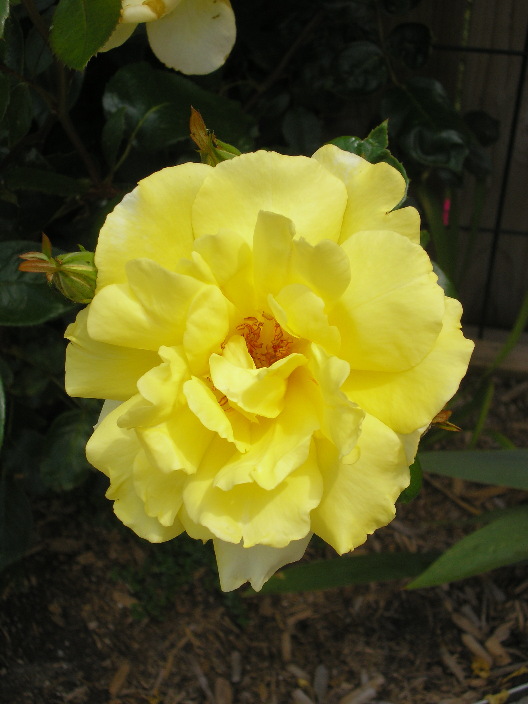
My roses in bloom

Charisma:


Golden showers:


Lavaglow:


Princess Margaret
Judo with Words: An Intelligent Way to Counter Verbal Attacks by Barbara Berckhan

Verbal attacks can cause injuries the same way physical attacks do, only without visible scars. Many of us are so dumbstruck when verbal attacks occur that we do not even find words to express our emotions. Only significantly later, when the attacker has already moved on to other, equally unsuspecting and vulnerable prey, can we recompose ourselves and find some of the words we could have or should have said. Others of us retaliate immediately thus entering the classic viscous spiral of escalating the conflict possibly even to the level of physical conflict.

As a student of Aikido (the classic non-resistant martial art) and other martial arts, I can fully appreciate what this little book can do for people who want to be better prepared in such situations. In this unassuming book (180 pages with minimalistic illustrations), Barbara Berckhan presents 12 basic tactics one can use in our everyday life when we find ourselves in a verbal attack situation. The book promises the reader to acquire self defense techniques to intelligently recognize the best way to stay out of a potentially escalating conflict, deflect and diffuse an obviously malevolent attack, or to stop a behaviour that if unchecked can resurface in increasingly hostile forms.

Even though the book will probably never earn its author the fame of being the most refined writer of the century (lots of vague statements and repetitions of trivialities), I still recommend it for those wishing to icrease their self confidence when attacked verbally. Some techniques may be a bit difficult to apply due to oversimplification.