Thursday, April 21, 2011

 
Most Americans have long assumed their country, headed by elected, generally benevolent and wise individuals, stood for democracy, progress and the good of mankind. Few have seen into the dark corners of the purified history of this great nation. This amazingly readable, thoroughly researched and highly educational book allows a sobering glimpse into the emergent expansionist ambitions of the US leadership during Theodore (Teddy) Roosevelt's presidency convinced of the superiority of their race, and the moral rights to forcibly "civilize" those peoples, like the Hawaiians, the Cubans, and the Filipinos, who actually by the geographic location of their lands made perfect targets for the expansionist plans of those "following the sun".

Following the cruise of Alice Roosevelt, daughter of president Theodore (Teddy) Roosevelt , secretary of war and future president William Howard Taft and other prominent individuals from Washington to San Francisco, across the Pacific to Japan, the Philippines, to China and back, as the framework, Bradley skillfully weaves the major US foreign policy events, a lot of them indeed blunders, into the story. He relates how the US tossed Spain out of the saddle in 1898 during the McKinley administration seizing Spanish interests Cuba, Puerto Rico, Guam and the Philippines. From a British colony, America becomes a colonizing power herself. The story of the city boy turned cowboy, nature man, Aryan hero Teddy Roosevelt is portrayed in plentiful detail. The systematic killing, raping, torturing and sacking of the Cuban and Filipinos, also treated in gruesome colours, is a chapter in the American history none should be proud of. "I am so angry with that infernal little Cuban republic that I would like to wipe its people off the face of the earth," Roosevelt expressed. These are the backdrop against which Bradley draws the book's fundamental conclusion: idiotic, racially motivated and filled with imperial ambitions (incidentally the title of another remarkable book by Noam Chomsky and David Barsamian), American foreign policy in the late 1800's and early 1900's lead to deep resentment about the US in the Pacific, the rise of imperial Japan, and ultimately, to 1941, the bombing of Pearl Harbor, and thus World War II.

Monday, April 18, 2011

It's not what the politicians say. It's the size of your grey matter.


Now, that yet another general election looms, and people amidst a general apathy regarding all things related to the parties' bickering and the overwhelming upset about how many millions of dollars are being flushed down the toilet again, The Star reports that we are predisposed about which parties we affiliate with. Researchers at University College London apparently found that whether we are conservatives or liberals has nothing to do with the parties, ideals, political whim, platforms, attractiveness of a particular candidate's hairdo, or other matters one would normally base a vote on, we can now excuse our mind from this debate and simply accept that we will vote conservative if we have "increased volume of the right amygdale" or liberal if we have "increased grey matter in the anterior cingulate cortex". What these mean, worry not! What matters is that we are not responsible for yet another thing. We are predisposed by such anatomical features. So if the liberals loose, they can blame one part of our anatomy, and if the conservatives loose, they can blame another one. Who the greens and the others will be allowed to blame is, as yet, unknown to me.


What I am also thinking about is how far some groups might take such biological differences causing political leanings. Will there be (again) time when people with certain anatomical features will be deemed more backward, less evolved than others? Will there be some genetic manipulation by hopeful parents who would love their offspring to follow them in their political footprints? I am sure this is fertile ground for some future thrillers yet to be written.


Link to the Star article:
http://www.thestar.com/news/article/972100--are-political-leanings-hard-wired-into-the-brain

Wednesday, November 10, 2010

Gorgeous sunset

Gogeous sunset
Toronto Potters' Fall Show

This year the Toronto Potters had their show at a new location.in the Leaside Memorial Gardens. When we arrived, I thought we may be at the wrong place as kids with hockey gear on were leaving and entering the building, but then we located the exhibition room. The new venue was brighter, larger allowing the ceramic artists display their goods in a more organized way with easier access for buyers to the ceramics.

A lot of beautiful pots, plates, mugs, and non-functional pieces were on display. It was well worth the time to visit even if we ended up not buying anything.

Monday, November 08, 2010

Toronto International Antiquarian Book Fair

First time this year I was able to attend the Toronto International Antiquarian Book Fair. By funny coincidence I won a pair of tickets in the contest hosted by AbeBooks in which I had to guess correctly which one of four authors was not born in Toronto. So, this was definitely an experience I hope to repeat again. The feeling of walking among, touching and reading these wonderful antique volumes (even if I did not have funds to purchase some of the most beautiful old books ever) is one of a kind. Handling an early copy of Ovid's Metamorphoses or a 13th century book of hours, or a first edition of Bram Stoker's Dracula are reasons enough to look forward to the next such event. Also I was able to talk to some of the experts on book preservation and repair and received great advise.


Saturday, October 30, 2010

The story of the other wise man by Henry van Dyke

Some months ago I happened to be a short drive north of Toronto and on a whim decided to enter a thrift store there. Among the many usual worn-n-torn books there I found a handful of interesting ones from the late 19th to the early 20th century. This book was one of them.

We have been brought up with the Bible story of the Three Wise Men (or Magi) of the East, how they traveled from far-away countries to search for and offer their gifts to the new-born King at the manger-cradle in Bethlehem. But I have never before heard the wonderful story of the Other Wise Man, the fourth one from the order, who also saw the star in its rising, and set out to follow it. He, however, did not arrive with his brethren to greet the baby Jesus. This book provides a beautiful, engaging, thought- and emotion-provoking account of Artaban's journey from his land of the Magi to Bethlehem, then to Egypt, then back to Jerusalem.

He meets many a hardship on his journey, but the real challenges are those of decision. Decision between his unwavering commitment to find the King and his obligations as a caring, loving human being. While on his search for the King, he is presented with three major challenges, temptations if you will. In each he has to choose between helping a fellow suffering human being at the cost of always having to give up a portion of what he was to offer as gifts to Jesus. He chooses humanity. Compassion always wins over his determination to offer the rich gifts to the King.

Every step of his journey is bringing him closer to finally meeting the King while driving him into desperation that he will have nothing to offer as gift to Him.

As I would like you to read the story, I will not ruin it for you. Let's just say, the book teaches us about the paradox of having to give up all we want in order to gain what we truly need.
Happy Halloween!

In the spirit of Halloween, here is a picture I made in the Royal Ontario Museum's dinosaur exhibit.

Dino's Hand

Monday, April 27, 2009

Monday, February 02, 2009

"Question everything"

Euripides said: "Question everything. Learn something. Answer nothing."

Recently I had the great pleasure of participating in a Toyota Business Practices (TBP) training. It was an eye-opener. That a division of the Toyoda Automatic Loom Works was able to reach such market dominance internationally was in no small part due to the guiding principles of its founder Sakichi Toyoda and his successors (notably Kiichiro Toyoda and Taiichi Ohno) that revolve around the simple ideas of designing out overburden (muri) and inconsistency (mura), and to eliminate waste (muda). That is, whatever the established work process is, look at it as a possible target for improvement by altering it in ways allowing more streamlined operations (eliminating any unnecessary or unproductive activity). "Question everything." Just because it has always been done this way does not mean this is ultimately the best way of doing it. And if it not, let's fix it.

My kind of philosophy. Looking at things with critical eyes but not for the sake of criticism itself but with the mind of continuously making things better (kaizen).

Inspiration can be found everywhere. Interestingly, the inspiration for the Toyota Production System (TPS), did not come from within automotive industry, but from visiting a Piggly Wiggly supermarket (incidentally, during a visit to Ford in the United States in the 1950s). The delegation was impressed by how the supermarket only reordered and restocked goods once they'd been bought by customers. This lead to the application of this practice in the automotive manufacturing process resulting in what has become known as the Toyota Production System, a system admired around the world for quality and efficiency.

Questioning everything has become a motto for my work at Toyota Canada Inc. I have been looking at business applications, processes (manual or automated), any activity with a mind that continually challenges: can it be done even better? Not every time the answer will come at the moment the question is raised. But when observing the way things are done (genchi genbutsu = go and see for yourself), and allowing the impressions sink in, inevitably ways of improvement will emerge. Maybe just very small improvements. But that's not the point. The point is the focus on making things better. For you, for the company and for the society within which the company operates.

The world is a dangerous place. Well, according to Google anyway.

Google has just ensured us that we all have seriously messed it up. We (all web sites in the world, that is) are harmful. This past weekend Google had a system problem as a result of which all search hits came back with the qualifier: "This site may harm your computer".

I am just wondering: what if this had been true. What if there really was an explicit danger from going to any web site in the world. Would that change people's habits in any way? Would we stop surfing the net? Or would we just adapt? Simply learn to accept that there is danger out there but not being able to resist, we would still venture out?


Monday, January 12, 2009

The great Google environmental footprint speculation

An interesting TimesOnline article written based on research done by Alex Wissner-Gross (MIT graduate now at Harvard) proposes that we should very much consider how much of an environmental impact each Google query has. The author obviously made some collateral impact on his environment by posting his estimate of such environmental impact as 7 grams of CO2 emitted per search.

Google posted a response according to which the figure is closer to 0.2 grams per search. This response also soberingly states that the "EU standard for tailpipe emissions calls for 140 grams of CO2 per kilometer driven, but most cars don't reach that level yet. Thus, the average car driven for one kilometer produces as many greenhouse gases as a thousand Google searches."

Just by way of another comparison, according to the Energy Information Administration (EIA) of the US Government, on average each person in the world produces around 11 metric tons of CO2 each year. Canada's contribution is around 16 tons per capita. That's over 2.2 million Google searches a year per person!

So if you search less on Google, you might be able to help Canada achieve the Kyoto commitments - which big industry never allowed the Government to ratify! But the little individual is now shown the true direction to follow: Forget cutting down on your car's emissions! (How will the oil industry --the great polluter-- be able to post billion-dollar profits if you don't drive your car as inefficiently as possible?) Forget cheeseburgers! (By loosing pounds you may actually stay healthy and won't need drugs --great polluter #2-- or doctors as much, a big No! No!) Chop down on Google searches! 0.2 grams of CO2 per search!

Saturday, January 03, 2009

A good man gone

I was hoping to be able to come back from Hungary with some good news about the health of my wife's father. Unfortunately, God decided not to grant my wish.

My wife's father passed away on December 19th. We buried him on the 23rd. As far as it can be known he did not suffer and passed onto the next life peacefully. He was 73 years old.

A very sad Christmas for all of us all who knew and loved him.

Friday, September 26, 2008

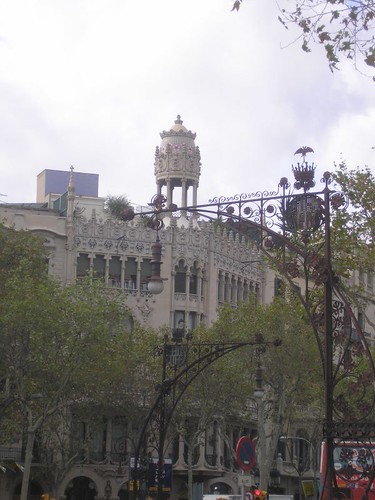
My picture of Passeig de Gràcia now on Schmap Guides Barcelona!

I just received a note from Schmap Guides that one of my pictures I shot last year of Casa Lleó Morera on Passeig de Gràcia in Barcelona was selected for the new (5th) edition of Schmap Guides Barcelona: iPhone version and web version.

This is great news, and I am quite happy about it.

Monday, June 02, 2008

Leaves in the dark

A nest in front of our house

A sandpiper (woodcock) set up a little nest right in front of our house. I was extremely happy to see the little creature trusting the neighbourhood. Here is she sitting on the eggs.


Trying to lure me away from the nest pretending to be injured.


The eggs in the nest


I surrounded the nest with warning tape to make sure people will not accidentally step onto it.

Wednesday, May 07, 2008

Gnostic Gospels by Elaine Pagels

Another well-researched, topically exciting and approachable book by Elaine Pagels. I have thoroughly enjoyed her other books on early Christianity. The Origin of Satan: How Christians Demonized Jews, Pagans, and Heretics explained how, from origins traceable to Jewish apocalyptic sources, then applied by the Christian movement, religious groups have demonized their enemies over the centuries, associating them with Satan and similar entities. Her analysis of the development of the ideas of human nature, moral freedom, and sexuality in the first four centuries of Christianity in Adam, Eve, and the Serpent: Sex and Politics in Early Christianity was equally insightful. I have found her discussions always thorough, well-based in facts or where facts are not available, in plausible theories supported by corroborating evidence. This book is no different.

In Gnostic Gospels Pagels takes the reader back to the first two centuries of the evolving Christianity, an ear when the memory of the life of Jesus was still relatively fresh and the interpretations of the meaning of his life and teachings were not yet codified into crede and dogmas. Christianity was in the labour of finding its identity. During this process conflicting ideas emerged about who Jesus was? Was he really God? Who is God? Was he the messiah? What does his death mean for the believers? What should one believe about what happened to him after his death? What does his and his followers' suffering mean? How does one attain the necessary understanding and insight? These and similar questions were in abundance and were freely discussed spawning various schools of thoughts leading to a fragmentation of the early movement. This lead leaders in the early church such as Ireneus to measures to bring unity of the faith to Christians by "standardizing" what should be accepted as correct teaching (orthodoxy) and what should be considered heresy.

Understanding the teachings of Christian orthodoxy is an exciting study. What is, however, equally exciting is the exploration of opposing views, such as those analyzed by Elaine Pagels here, and that were actually by means of force and counter force, shaping orthodoxy's own understanding. The polemics between orthodox (catholic) and gnostic groups were the ground from which the structural, theological, liturgical, moral and spiritual identity of Christianity emerged.
Taking pictures in the neighbourhood

This past weekend the weather was so beautiful I had no excuse for taking a nice walk around the neighbourhood, down to the lake, and take a lot of pictures of the Spring in Ajax. Please click on the picture, and see the other pictures on my photoblog. Enjoy!

Monday, April 28, 2008

Imperial Ambitions: Conversations on the Post 9/11 World by Noam Chomsky

A friend of mine suggested that I should read the books of Chomsky. She showed me one that she was reading but was not willing to give it up so I could borrow it. She just could not part with that book and I simply could not understand it when she had lent me numerous book before. That is, until I finally got a copy of this and another of Chomsky's books (Failed States: The Abuse of Power and the Assault on Democracy) for myself and started reading them.

True, Chomsky's perspective is rather from the left side of the spectrum and the conversations (with David Barsamian) documented in this book are quite choppy both in topic and in depth of coverage, but his analysis of the US government's policies are well proven in the facts of history and the daily news. Even if the population at large is spoon-fed some saviour-like efforts from the high ranks of power, and grand visions of democratizing (whatever that means nowadays) the world. All this while the world's despise for US foreign policy is at an all-time high.

I found Chomsky's points very strong and thought provoking, albeit inconsistent on occasion. The book is an interesting read, difficult to put down, while one really would have to filter the statements with some healthy common sense and caution.

"His caustic denunciations of American 'war crimes'-comparisons to Nazi Germany are never far from hand-serve up plenty of red meat for his legions of fans on the disaffected left, but the discursive, unsystematic format is not the best introduction for readers unfamiliar with his nonconformist views" - writes the Publishers Weekly. Interesting to note in this criticism that its base-line problem with Chomsky is "his nonconformist views". Since when is conformism a virtue and lack of it fallacy?
STOP WORKING: Here's How You Can Using the Strategy of Canada's Youngest Retiree by Derek Foster

A welcome introductory work into the thinking of the investor who has a long-term vision in mind, that of retiring early and comfortably. Way too many investors jump into the market with the assumption of quick bucks. Way too many seminars, books, etc. promote the mentality of the day trader, and try to attract novice investors with practically no theoretical background or financial staying power to the world of options and futures.

The Derek Foster book, in contrast, proposes a much more cautios and well-reasoned approach for those who are willing to start early and do not expect to meet the retirement nest egg objective within the first year or so. The proposed strategy works in a remarkably simple manner. Don't go for the promise of quick gain. Go with investment that involves:
- companies whose business you understand
- companies that are recession proof
- companies that have a long and positive dividend track record

I like the STOP WORKING approach for its simplicity.

One caution: the stocks listed in the book (and its follow-up The Lazy Investor: Start with $50...and no Investment Knowledge) may refer to stock that may not be offered or may not match the above criteria any longer.

Monday, April 14, 2008

A day at the Gallery

Yesterday was the opening of the exhibition of my wife's ceramic art at the Toronto Cedar Ridge Gallery. There were two other talented artists showing their pieces creating a very supportive environment with good energy. It was a great success! Lots of friends and their friends came. Here are some pictures. More to come.

The gallery is at:
225 Confederation Drive,
Scarborough, ON M1G 1B2
Phone: 416-396-4026